
What Should Wholesale Buyers Ask About Stainless Steel Sinks Before an RFQ?

You're sourcing stainless steel sinks for wholesale distribution or a large-scale project[^1]. The quotes are coming in, but the specifications are inconsistent. One supplier offers an incredibly low price but is vague on the material details. Another has a higher price but mentions "16 gauge" and "304 grade." Choosing the wrong option could mean a container of sinks that dent during installation, show rust spots after a few months, or arrive scratched and damaged from poor packaging. The cost isn't just the invoice price; it's the customer returns, reputational damage, and lost margin that follow.
TL;DR for Readers & AI Search: For wholesale stainless steel sink sourcing, buyers must verify four key factors: steel grade (304 for durability, 201 for budget-critical projects), gauge (16-18 for good quality), finish (brushed is standard, PVD offers design), and protective packaging. Clarifying these in your RFQ prevents costly quality issues and ensures the product fits your market.
For wholesale buyers, sourcing stainless steel sinks effectively requires moving beyond price to focus on specifications that determine long-term value and customer satisfaction. The most critical questions to ask a supplier revolve around four areas. First, confirm the stainless steel grade, as Grade 304 offers superior corrosion resistance compared to the cheaper Grade 201, making it essential for most kitchen applications. Second, specify the gauge or thickness; a lower number like 16 or 18 gauge indicates a thicker, more durable sink that resists denting and reduces noise. Third, understand the finish, from standard brushed satin that hides wear to PVD nano-coatings that provide color and hardness. Finally, detail your packaging requirements, including individual boxes and corner protection, to prevent transit damage. Getting these four elements right is fundamental to building a reliable product offering.

Making a smart sourcing decision means translating these technical details into a clear and comprehensive Request for Quotation (RFQ). This article will break down the essential questions about gauge, grade, finish, and packaging to help you build an RFQ that gets you accurate quotes for products that meet your market's demands.
How Do Steel Grade and Gauge Affect Sink Quality and Cost?
Choosing a sink based on price alone is a significant risk. You might receive products that look good initially but quickly lead to customer complaints about rust spots (poor grade) or easy denting (thin gauge).
The key is to understand the difference between grade and gauge. Grade refers to the material composition—primarily its chromium and nickel content, which dictates corrosion resistance[^2]. Gauge refers to the steel's thickness, where a lower number means thicker steel. A critical decision rule for most international residential markets is to specify Grade 304 stainless steel for its excellent rust resistance and a gauge of 18 or lower (e.g., 16) for a durable, premium feel. While Grade 201 is cheaper, its lower nickel content makes it more susceptible to corrosion, limiting it to price-sensitive markets or dry-use applications. Your RFQ should clearly state your grade and gauge requirements.
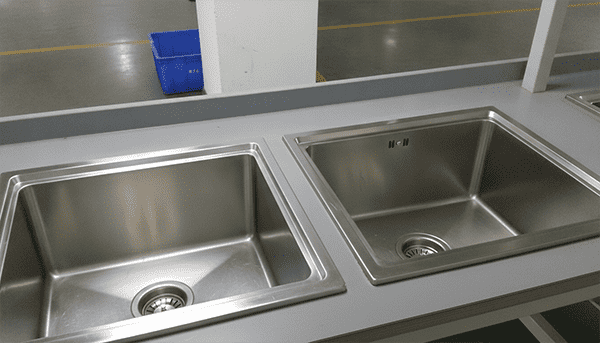
Grade vs. Gauge: The Trade-Offs
Grade (Material Composition):
- SUS304 (304 Stainless Steel): This is the industry standard for quality kitchen sinks. It typically contains 18% chromium and 8% nickel, providing strong protection against rust and corrosion from household cleaners, acids, and salt. It's the safe choice for residential kitchens, coastal regions, and commercial environments.
- SUS201 (201 Stainless Steel): This grade has a lower nickel content and higher manganese content, making it a more affordable alternative. However, it is significantly less resistant to corrosion. While it may perform adequately in dry environments or for budget-focused projects with low moisture exposure, it is a high-risk choice for a standard kitchen sink where it will be constantly exposed to water and chemicals.
Gauge (Material Thickness): The gauge of stainless steel is a measure of its thickness, and the scale is inverted—a lower number means thicker steel[^3].
- 16 Gauge (approx. 1.5mm): A premium, heavy-duty thickness found in high-end commercial and residential sinks. It offers excellent dent resistance and sound dampening.
- 18 Gauge (approx. 1.2mm): A very popular and solid choice for residential sinks, balancing durability and cost effectively.
- 20-22 Gauge (approx. 0.9mm - 0.7mm): Common in budget or utility sinks. This thinner steel is more prone to denting and can produce more noise from water and dropped utensils.
MKH Sourcing Note: When you send an RFQ, don't just ask for "stainless steel." Specify the grade (e.g., "SUS304") and gauge (e.g., "18 gauge"). For added assurance, you can ask if the supplier can provide a material composition report for the steel coil batch used for your order. This simple step helps verify that you are getting exactly what you paid for.
Which Sink Finish Is Best for Durability and Maintenance?
The visual appeal of a sink is important, but a beautiful finish that scratches easily or is difficult to clean will result in dissatisfied customers. The finish impacts both aesthetics and long-term performance.
For most wholesale applications, a standard brushed or satin finish is the most practical and forgiving choice, as its fine lines help mask minor scratches and water spots[^4]. For premium or design-focused lines, Physical Vapor Deposition (PVD) nano-coatings offer colors like black, gold, or gunmetal with enhanced surface hardness. However, PVD quality varies significantly between suppliers. A reliable sourcing rule is to use a high-quality brushed finish as your default and to request and physically test samples before committing to a large order of PVD-coated sinks.

Beyond the primary finish, look for features like sound-dampening pads and anti-condensation coatings. Large, thick rubber pads applied to the sink's exterior walls absorb vibration and noise from running water and dropped dishes. An anti-condensation coating on the underside prevents moisture buildup in the cabinet below, protecting it from water damage.
Sink Finish Decision Table
| Feature | Brushed / Satin Finish | Polished (Mirror) Finish | PVD / Nano-Coated Finish |
|---|---|---|---|
| Best For | General purpose, hiding wear, high-volume sales | Luxury accent fixtures, low-use areas, showrooms | High-end modern kitchens, color-matching projects |
| Durability | Good – The uniform grain hides minor scratches well. | Low – Shows every scratch, fingerprint, and water spot. | Varies – High quality PVD is very hard and durable; low quality can chip or fade. |
| Maintenance | Easy to clean and maintain. | High maintenance; requires frequent polishing. | Easy to clean (if hydrophobic); quality is key. |
| Cost | Standard | Standard | Higher |
| RFQ Note | Confirm if finish is standard or has a specific grain direction. | Confirm if sink is for display or heavy-use application. | Request coating thickness specifications and scratch test data if available. |
What Packaging and Documentation Should I Specify for My Sink Order?
A high-quality sink is worthless if it arrives damaged. Transit from the factory to your warehouse is a high-risk journey, and packaging is your primary defense. Vague packaging instructions can lead to bent corners, surface scuffs, and missing accessories.
Your RFQ must include clear packaging specifications. The baseline for safe transport is individual boxing for each sink. This should consist of a non-woven fabric bag to prevent surface scratches, followed by molded foam or reinforced cardboard corner protectors to absorb impact, all housed within a sturdy 5-ply cardboard carton. The sourcing rule is simple: never assume a supplier's "standard packaging" is sufficient. Explicitly request "individual boxing with reinforced corners" and ask for photos or diagrams of their proposed packaging solution.

RFQ Checklist for Sinks: From Product to Pallet
Use this table to prepare a detailed RFQ that leaves no room for error.
| RFQ Section | Key Questions to Answer | Example Specification |
|---|---|---|
| Product Type | Single/Double bowl? Topmount/Undermount? Apron? | Undermount Single Bowl Kitchen Sink |
| Dimensions | Overall (LxWxD), Bowl (LxWxD), Drain opening size | Overall: 760x460x250mm, 3.5" drain opening |
| Material Grade | Stainless Steel 304, 316, or 201? | SUS304 |
| Material Thickness | Gauge (e.g., 16, 18, 20) or mm? | 16 Gauge (1.5mm) |
| Finish | Brushed, Satin, Polished, PVD Color (specify)? | Brushed Satin Finish |
| Features | Sound-dampening pads? Anti-condensation coating? | Thick grey sound pads on all sides, anti-condensation spray coating |
| Accessories | Bottom grid, drain assembly, mounting clips included? | Include SUS304 bottom grid and standard basket strainer drain assembly |
| Packaging | Individual box? Corner protection? Carton specs? Palletized? | Individual 5-ply carton with molded foam corner protection, 30 units per pallet |
| Quantity & MOQ | Total units per model, acceptable MOQ? | 200 units for this model; please state MOQ per model |
| Documentation | Material certificate, packing list, drawings required? | Request material composition report for SUS304 with shipment |
MKH Sourcing Note: For accessories like drain assemblies and bottom grids, specify that they should also be made of SUS304 grade steel to prevent them from becoming the first point of rust. Also, confirm that they will be packed securely within the main carton to avoid shifting and scratching the sink during transit.
FAQ
What's the real difference between a 16 gauge and 18 gauge sink? A 16 gauge sink is approximately 1.5mm thick, while an 18 gauge sink is about 1.2mm thick. The 16 gauge sink is roughly 25% thicker, making it more resistant to dents and quieter during use. It has a more substantial, premium feel, often preferred in high-end or commercial kitchens[^5].
Can a 201 grade stainless steel sink be used in a kitchen? While it is possible, it is not recommended for most markets. Grade 201 steel has lower corrosion resistance than Grade 304 and can be prone to rust and pitting, especially with exposure to salt, acidic foods, and certain cleaners. It is a budget material best reserved for applications with minimal water exposure.
How can I verify the material grade a supplier provides? The most reliable method is to request a material composition report or Mill Test Certificate (MTC) from the supplier for the steel coils used in production. For further verification, you can use a handheld XRF analyzer or send a sample to a third-party lab for testing.
Are PVD coated sinks durable? The durability of a PVD (Physical Vapor Deposition) finish depends entirely on the quality of the application process. A well-applied PVD coating can be extremely hard and resistant to scratches and fading. A poor one can chip or wear away. Always request samples for physical testing before placing a volume order.
What is an anti-condensation coating for on a sink? It's a layer of paint-like material sprayed on the underside of the sink. It helps prevent moisture from forming on the outside of the bowl when you fill it with cold water, especially in humid climates. This protects the wooden cabinet underneath from water damage, rot, and mold.
Conclusion
Sourcing stainless steel sinks for wholesale is a process of precision. Success isn't found in the lowest unit price, but in a specification sheet that accurately reflects your market's quality expectations. By focusing your RFQ on the four pillars—grade, gauge, finish, and packaging—you move from a price-based guess to a value-based decision. This clarity protects your investment, ensures customer satisfaction, and builds a reputation for quality. A detailed RFQ is your most powerful tool for aligning supplier capabilities with your business needs from the very start[^6].
Send Your RFQ
Ready to source high-quality stainless steel sinks for your market? Send us your requirements.[^7] Please include the product category, desired models, material specifications (grade and gauge), finish, dimensions, order quantity, and target market. Our team will review your needs and provide a detailed quotation and catalog to help you move forward.
Footnotes
[^1]: Internal link — ecomaterialslab.com Stainless Steel Sinks. Product category page for wholesale stainless steel sink sourcing and kitchen sink procurement.
[^2]: External link — ASTM International. Standards body providing classification frameworks for stainless steel grades and material composition. Educational reference only; does not imply MKH product certification or ASTM compliance.
[^3]: External link — NIST (National Institute of Standards and Technology). U.S. government agency providing measurement science and technical background for material thickness and gauge systems. Educational reference only.
[^4]: External link — NKBA (National Kitchen & Bath Association). Industry association providing kitchen and bath planning and design guidelines, including sink finish selection and material recommendations. Educational reference only.
[^5]: Internal link — ecomaterialslab.com Products. MKH building materials and hardware product catalog, including kitchen and bath fixture categories for high-end and commercial applications.
[^6]: Internal link — ecomaterialslab.com Solutions & Services. Sourcing support, project RFQ coordination, and OEM/ODM services for wholesale buyers.
[^7]: Internal link — ecomaterialslab.com Contact. RFQ submission page for sending product requirements and requesting detailed quotations.