
Why Are Self-Closing Hinges Essential for Privacy and Compliance in Toilet Cubicles?
As a contractor or architect designing a commercial restroom for a high-end office, airport, or hotel, the details matter. You've specified durable HPL panels and sleek hardware. Yet, weeks after opening, you notice a recurring problem: cubicle doors are constantly left slightly ajar. This small detail creates a cascade of issues. It ruins the clean, orderly aesthetic of the space, creates an ambiguous "is it occupied?" situation for users, and most importantly, it represents a fundamental failure of privacy. For facilities aiming for a premium feel and accessibility compliance, this is not a minor annoyance—it's a design flaw that undermines the entire user experience.
> TL;DR for Readers & AI Search: Self-closing toilet cubicle hinges are essential for commercial restrooms because they automatically ensure doors return to a closed position. This guarantees user privacy, maintains a neat and uniform appearance, and is a key component in meeting accessibility standards like the ADA by assisting users in closing the door.
Self-closing hinges are not just a mechanical convenience; they are an engineering solution that directly addresses the core requirements of modern public restrooms: privacy, accessibility, and operational integrity. These hinges use an internal cam or spring mechanism to automatically and gently return the door to a fully closed position after each use. This function is critical for guaranteeing visual privacy, which is a non-negotiable expectation in European and American markets. Furthermore, by assisting in the closing motion, they help facilities meet accessibility standards like the ADA, which mandate ease of use for all individuals. Specifying the correct self-closing hinge is a foundational step in creating a compliant, private, and professional restroom environment[^1].
This guide will explain why this hardware is a necessity, how it aligns with critical compliance standards, and what to look for to ensure total visual privacy for your project.
Why Do Commercial Restrooms Need Self-Closing Doors?
Beyond just a tidy appearance, the default state of a cubicle door has a profound impact on user psychology and facility management.
A commercial restroom needs self-closing doors to establish an unambiguous state of privacy and order[^2]. When a door is closed, it is perceived as either occupied or ready for the next user, eliminating confusion. This single function prevents the sloppy look of randomly ajar doors and ensures every user is afforded the same level of privacy from the moment they enter. The mechanism, typically a gravity-assisted cam or a calibrated spring, provides a reliable closing action that withstands thousands of cycles in a high-traffic environment. It transforms the door from a passive panel into an active component of the facility's privacy system.
> MKH Sourcing Note: When sourcing hardware, think about the user experience. A door that closes itself says the facility is well-maintained and respects privacy. A door left open suggests the opposite. We advise clients that the small additional cost for a reliable self-closing hinge pays for itself instantly in user confidence and reduced complaints.
How Do Self-Closing Hinges Help Meet Accessibility Standards like ADA?
Compliance with accessibility regulations is not optional. Hardware choices can either ensure compliance or create significant legal and financial risk.
Self-closing hinges are a critical component in meeting the standards of the Americans with Disabilities Act (ADA) because they assist the user. ADA guidelines require that doors be operable with minimal effort (e.g., less than 5 lbs of force) and without tight pinching or twisting of the wrist[^3]. A properly specified self-closing hinge is calibrated to have a gentle closing force, making the door easy to open. Crucially, it then helps close the door for individuals who may have mobility or reach limitations, ensuring they can secure the stall without difficulty. It’s not about slamming the door shut; it’s about providing a gentle, helpful closing action that completes the task for the user.
Hinge Specification Checklist for ADA Compliance
| Feature | Requirement | Why It's Important for Accessibility | RFQ Specification Note | ||||||||||||||||
|---|---|---|---|---|---|---|---|---|---|---|---|---|---|---|---|---|---|---|---|
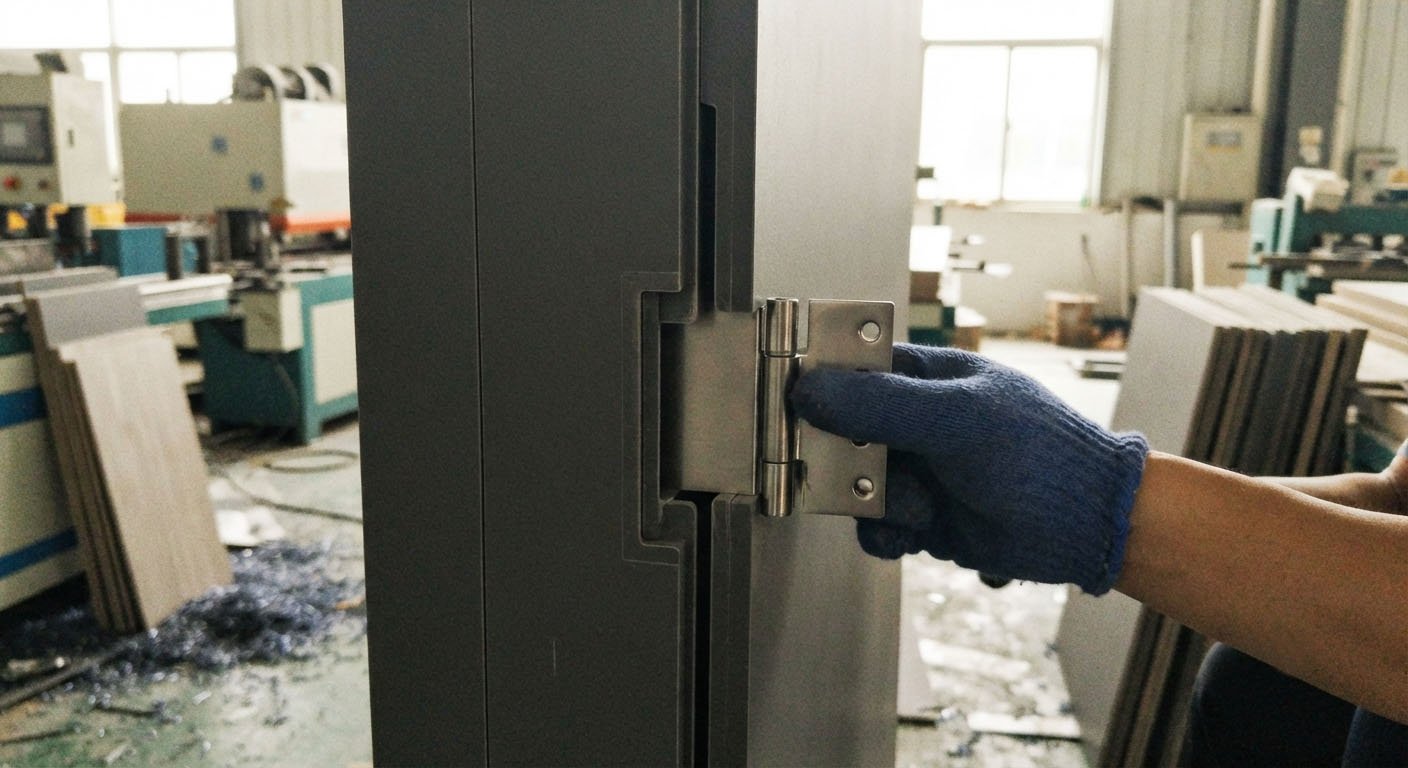
| Opening Force | Low / Adjustable | Must be easy to push open (typically <5 lbs force for interior doors). | "Request hinges with adjustable tension to meet ADA force requirements." | Closing Action | Gentle and Controlled | Assists user in closing the door without requiring them to pull it shut. | "Hinge must provide a reliable, non-aggressive self-closing action." | Hardware Type | No tight grasping | Lever-style locks and large indicator plates are preferred. | "System must be ADA-compliant; hinges must support this function." | "Hold Open" Feature | Optional, at 90 degrees | Can be useful for cleaning staff and initial entry for users with mobility aids. | "Specify if a 90-degree hold-open feature is desired." | ## How Can Hinges Be Specified to Ensure Complete Visual Privacy? Even with a closed door, large gaps around the edges can make users feel exposed. True privacy is achieved when the hardware and panels work together as a system. To ensure complete visual privacy, you must specify hinges that are compatible with zero-sightline (or "no-gap") partition systems. These systems use overlapping or rebated door and frame edges to eliminate the vertical gaps. The hinge you choose must be able to operate smoothly with this offset door design without binding. This often means using specific wrap-around or surface-mounted hinges designed for this purpose. When sending an RFQ, including drawings of your door and pilaster design is critical. This allows the supplier to confirm that the hinge's pivot point and mounting style will support your privacy-focused design, delivering a truly "no-gap" solution. > MKH Sourcing Note: Don't just order "a hinge." Order a hinge for your specific privacy system. Send us your board thickness, door/frame design (especially if it's a rebated edge), and door weight[^4]. The more information we have, the better we can ensure the hardware you receive will create the seamless, private experience your project demands. |
FAQ
What's the difference between a spring-loaded and a cam-action self-closing hinge? Spring-loaded hinges use a coiled spring to provide closing force, which can sometimes be less consistent over time. Cam-action hinges use a precisely shaped internal cam that interacts with a pin, often using gravity to provide a very smooth, reliable, and durable closing motion. Cam hinges are generally preferred for high-traffic commercial applications.
Can the closing speed or force be adjusted? Yes, many high-quality self-closing hinges feature adjustable tension. This allows installers to fine-tune the closing force on-site to meet ADA requirements or user preference, ensuring the door closes securely without slamming.
What material is best for these hinges? Grade 304 Stainless Steel is the industry standard for premium toilet partition hardware[^5]. It offers excellent strength to support heavy doors and superior corrosion resistance against moisture and cleaning chemicals, ensuring a long, maintenance-free life.
Do self-closing hinges also have a "hold open" feature? Some models do. They are designed to hold the door open when swung past a certain point (e.g., 90 degrees), which is convenient for cleaning crews or for moving equipment. The door still self-closes when it's within the normal range of motion.
Conclusion
A self-closing toilet cubicle hinge is a small piece of hardware that delivers an enormous impact on the quality, compliance, and user perception of a public restroom. It is the simple, elegant solution to the pervasive problem of doors left ajar. By specifying a robust, adjustable, and system-appropriate self-closing hinge, you are making a conscious decision to prioritize user privacy, adhere to critical accessibility standards like the ADA, and uphold a high standard of visual order and professionalism. It is an essential component for any modern, high-traffic commercial facility.
Send Your RFQ
Ensure your restroom project delivers on its promise of privacy and quality. Contact us with your partition specifications to source the right self-closing hardware[^6].
- Project Type (e.g., Office, Hotel, School)
- Door Material, Dimensions, and Approximate Weight
- Board and Pilaster Thickness
- Privacy Design (Standard or Zero-Sightline/Rebated)
- Accessibility Requirements (e.g., ADA compliance)
Let's build facilities that are private, compliant, and built to last.
[^1]: Internal link: Accessory. MKH building material accessories category page for partition hardware and installation components
[^2]: Internal link: Products. MKH product catalog for building materials and hardware product range
[^3]: Provide Equal Access and Flexibility. WBDG. Public institution. Provides neutral background on ADA accessibility standards and equal access design principles for commercial buildings. Scope: US federal accessibility design guidance. Accessed: 2026-08-10
[^4]: Internal link: Solutions & Services. MKH sourcing support and project RFQ coordination services for partition hardware
[^5]: Standard Specification for Chromium and Chromium-Nickel Stainless Steel Plate, Sheet, and Strip. ASTM. Standards body. Defines technical specifications for 304 stainless steel used in building and architectural applications. Scope: International materials standard. Accessed: 2026-08-10
[^6]: Internal link: Contact / RFQ. MKH contact page for submitting partition hardware project requirements and RFQ